Fix Your Pool Water
What's wrong with your pool? Find the exact commercial-grade chemicals our DFW technicians use daily to solve every water problem.
What Chemicals Does Every Pool Need?
Ignore the wall of bottles — every residential pool runs on five essentials. Everything else is situational. If you're starting from zero, this is the shopping list:
Sanitizer
Chlorine tablets, liquid chlorine, or your salt cell — the constant 1-3 ppm that keeps water safe.
Shop Chlorine tablets →Shock
Weekly oxidizer dose + your emergency response to algae, storms, and pool parties.
Shop Pool shock →Balancers
Muriatic acid, alkalinity increaser, calcium — they protect your equipment and make chlorine work.
Shop Balancers →Stabilizer
Cyanuric acid is sunscreen for chlorine — without 30-50 ppm, Texas sun burns it off in hours.
Shop Stabilizer →Test Kit
Every dose depends on a reading. Strips for daily checks, a Taylor kit for the truth.
Shop Test kits →Shop by Category
My Pool is Green
Green water means algae is growing — usually caused by low chlorine levels, poor circulation, or a recent storm washing debris into the pool. Here's the exact treatment protocol our techs follow:
Treatment Protocol
- 1Brush walls and floor
Break up algae colonies so chemicals can reach them. Pay extra attention to corners and steps.
- 2Super-shock the pool
Use 3-4x the normal shock dose. For a standard 15,000-gallon pool, that's 3-4 lbs of Cal-Hypo shock. Run the pump 24/7.
- 3Wait 24-48 hours
Let chlorine levels drop below 5ppm before adding algaecide. Test with a strip or digital kit.
- 4Add algaecide
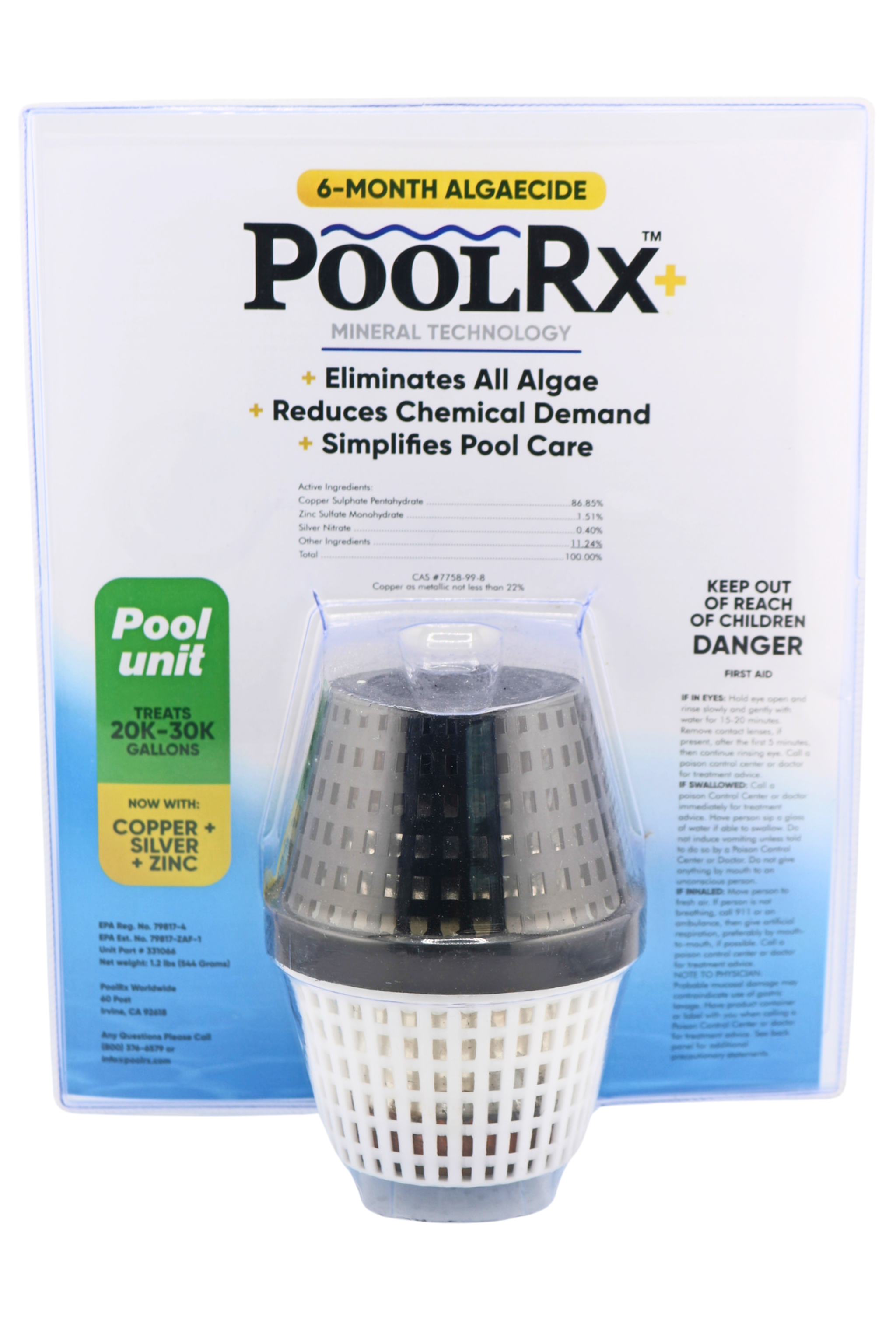
Apply a copper-based or poly-based algaecide to kill remaining spores and prevent regrowth.
- 5Clarify and filter
Dead algae turns water cloudy white. Add a clarifier to coagulate particles so your filter can catch them. Clean the filter frequently.
Products You Need for a Green Pool
My Water is Cloudy
Cloudy water is caused by microscopic particles too small for your filter to catch — dead algae, calcium buildup, sunscreen, or fine debris. The fix depends on the cause:
How to Fix It
Add a clarifier to coagulate dead algae and fine particles. Run the pump 24/7 and clean the filter every 8 hours until water clears.
Test chemistry first — high calcium or pH causes haze. Balance water, then add an enzyme clarifier to break down oils and organic buildup.
Use a flocculant — it sinks particles to the floor where you vacuum them to waste. Faster than a clarifier but requires manual vacuuming.
Check your filter — it may need cleaning, new cartridges, or fresh DE powder. A worn-out filter can't clear water no matter how many chemicals you add.
Clarifiers & Water Polishers
Water Chemistry & Balancing
Balanced water prevents scale buildup, protects your equipment, and makes chlorine work efficiently. Here's what each measurement means and how to fix it:
| Parameter | Ideal Range | Too Low? Add... | Too High? Add... |
|---|---|---|---|
| pH | 7.2 – 7.6 | Soda Ash (Sodium Carbonate) | Muriatic Acid or Dry Acid |
| Alkalinity | 80 – 120 ppm | Alkalinity Increaser (Sodium Bicarbonate) | Muriatic Acid (add slowly) |
| Calcium Hardness | 200 – 400 ppm | Calcium Hardness Increaser | Partial drain & refill (no chemical fix) |
| Cyanuric Acid (CYA) | 30 – 50 ppm | Stabilizer / Conditioner | Partial drain & refill (no chemical fix) |
pH, Alkalinity & Hardness Products
Daily Sanitization & Chlorine
Your pool needs a constant level of chlorine (1-3 ppm) to kill bacteria and prevent algae growth. Here are the two main methods:
Chlorine Tablets (Trichlor)
3-inch tabs placed in a floating dispenser or inline chlorinator. They dissolve slowly over days, providing steady chlorine release.
- + Set-and-forget convenience
- + Contains built-in stabilizer (CYA)
- - Can raise CYA over time (requires monitoring)
- - Very acidic — lowers pH over time
Liquid Chlorine (Sodium Hypochlorite)
Poured directly into the pool — fast-acting and leaves no residue. Used by most professional pool services including ours.
- + No CYA buildup — won't over-stabilize
- + Instant sanitization
- + What the pros use
- - Must add daily/weekly (not time-released)
- - Heavy liquid jugs to handle
Chlorine, Tablets & Sanitizers
Salt Water Pool Chemicals
"Salt pool" doesn't mean "chemical-free pool" — your salt cell manufactures chlorine, and everything else about water chemistry still applies. Here's what salt-pool owners in DFW actually buy:
Still required on every salt pool
- Muriatic acid — salt cells continuously push pH upward; most DFW salt pools need acid more often than tab pools, not less.
- Stabilizer (CYA) — cell-generated chlorine is unstabilized; without 60-80 ppm CYA (salt pools run higher), the sun eats your cell's output.
- Pool salt — splash-out, backwashing, and rain dilution drop salt levels every season. Cells typically want 2,700-3,400 ppm.
- Shock — after storms, parties, or algae, the cell alone can't catch up. Liquid chlorine or cal-hypo bridges the gap.
Salt-pool specifics worth knowing
- Calcium matters more — high calcium scales the cell plates and kills cells years early. On well water (Argyle, Bartonville) this is the #1 salt-cell killer we see.
- Descale annually — an acid-bath cell cleaning each season often buys 1-2 extra years of cell life.
- "Low salt" isn't always low salt — a scaled or dying cell misreads salinity. Test independently before dumping bags in.
The North Texas Pool Chemical Calendar
Chemical demand in DFW swings hard with the seasons — the routine that works in April will lose a pool in July. This is the schedule our service techs actually run across Denton County:
Spring (Mar-May)
- •Full water test after winter — expect CYA and calcium drift
- •Reset balance before heat arrives; stock stabilizer
- •Pollen season: extra clarifier + frequent filter cleans
- •Storm season begins — shock after every major blow-in
Summer (Jun-Sep)
- •Peak demand: chlorine burn-off doubles above 90°F water
- •3-5 tablets/week typical; weekly maintenance shock
- •Watch CYA creep from trichlor — test monthly
- •Algae window: phosphate remover earns its keep now
Fall (Oct-Nov)
- •Leaf load spikes tannins — skim daily, enzyme clarifier helps
- •Taper chlorine as water cools below 70°F
- •Last algaecide dose before dormancy
- •Book winterization before the first freeze warning
Winter (Dec-Feb)
- •Pools run, just slower — 1-2 tablets/week keeps sanitation
- •Balance still matters: cold water dissolves plaster faster at low pH
- •Freeze events: run equipment, verify freeze guard
- •Cheapest season to fix chemistry mistakes — test monthly
Test Your Water
You can't fix what you can't measure. Strips for daily checks, liquid kits for the comprehensive monthly test, reagents to refill your kit, and digital testers when you want continuous data. Pin specific SKUs in admin → category pages to control what surfaces here.
Test Strips
All test strips →7-way strip packs for fast daily / weekly chlorine + pH spot checks. Fresh manufacture dates, sealed bottles.
Liquid Test Kits
All liquid kits →Taylor K-2006 and other professional reagent kits — the only sub-$100 path to reliable CYA, calcium hardness, and FAS-DPD chlorine readings.
Replacement Reagents
All reagent refills →Refills for Taylor, LaMotte, and Poolmaster kits. R-0871 (FAS-DPD) and R-0013 (CYA) wear fastest — keep spares.
Digital Testers & Smart Monitors
All digital testers →Photometers, ORP/pH meters, and continuous monitors. Best as a complement to a Taylor K-2006, not a replacement — most digital tools skip CYA / TA / CH.
Not sure what chemicals you need?
Bring a water sample to our Northlake store for a free digital spin-touch analysis. We'll tell you exactly what your pool needs and how much to add.
Chemical Safety & Dosage Accuracy
All dosage recommendations on this page are based on NSPF/PHTA CPO Handbook standards and manufacturer Safety Data Sheets (SDS). Actual dosages vary by product concentration, water temperature, and conditions. Always read the product label and SDS before use. SDS documents are available from each manufacturer or upon request from our team. For professional dosing assistance or a free water analysis, call (469) 455-1054 or bring a water sample to our Northlake store.
Free Tools & Guides
Pool Volume & Dosing Calculator
Get your exact gallons, then dose right the first time.
Free In-Store Water Testing
Bring a sample to Northlake — full digital analysis + printed plan.
How to Shock a Pool (Guide)
Step-by-step, with dosing by pool size.
Chemical Dosing Calculator (Guide)
Our most-read chemistry article.
Weekly Pool Service from $165/mo
Chemicals included — never think about this page again.
Green-to-Clean Rescue
Swamp to swimmable in 5-10 days, chemicals included.
Local delivery pages: Northlake · Argyle · Flower Mound · Southlake · Trophy Club — same-day on orders by 2 PM.
Frequently Asked Chemistry Questions
What chemicals does every pool need?
Five essentials: (1) a sanitizer — chlorine tablets, liquid chlorine, or a salt cell; (2) shock for weekly oxidation and algae response; (3) balancers — muriatic acid or pH up, alkalinity increaser, calcium hardness increaser; (4) stabilizer (cyanuric acid) to protect chlorine from Texas sun; and (5) a test kit, because every dose depends on a reading. Algaecide and clarifier are situational, not weekly.
How much shock do I need for my pool?
Routine weekly shock: 1 lb of cal-hypo per 10,000 gallons. Algae treatment: 2-3 lb per 10,000 gallons depending on severity. A typical 15,000-gallon DFW pool takes 1.5 lb weekly and 3-4.5 lb for a green-pool rescue. Use our free pool calculator to get your exact gallons, then dose from the product label.
Can I add shock and algaecide at the same time?
No. Adding high levels of chlorine (shock) simultaneously with standard algaecides will destroy the algaecide polymers, rendering them useless. Always shock first, wait 24-48 hours for chlorine levels to drop below 5ppm, and then apply algaecide.
Why is my pool cloudy after shocking?
This is common and usually a good sign! Granular shock (Cal-Hypo) can naturally cause temporary cloudiness as it dissolves. Alternatively, if the shock killed a large amount of algae, the microscopic dead algae turn the water cloudy white. Use a Clarifier to help your filter catch these dead particles.
How do I lower my pool's pH?
You must use Muriatic Acid or dry Sodium Bisulfate (Dry Acid). Always add acid to the deep end of the pool while the pump is running vigorously. Never pour acid into the skimmer, as this will highly concentrate the acid and destroy your pump seals and heater core.
How long after adding chemicals can I swim?
Balancers (pH, alkalinity, calcium): 30 minutes to 1 hour with the pump running. Liquid chlorine at maintenance dose: about 4 hours. Shock: 24 hours, or whenever free chlorine tests below 5 ppm. Muriatic acid: 30 minutes minimum with good circulation. When in doubt, test first — never swim above 5 ppm free chlorine.
Do salt water pools need chemicals too?
Yes — a salt pool makes its own chlorine, but everything else still applies. You still balance pH (salt cells push pH up, so most DFW salt pools need regular muriatic acid), still maintain stabilizer, still watch calcium, and still shock after storms or heavy use. Plus pool salt itself when levels drop from splash-out and backwashing.
Why do DFW pools need different chemical care than other regions?
Three local factors: intense UV from March to October burns off unprotected chlorine within hours, so stabilizer management matters more here; municipal water across Denton County trends alkaline and moderately hard, so most pools drift up in pH and need acid regularly; and communities on well water (Argyle, Bartonville, Copper Canyon) fight iron and very high calcium, which changes shock choice and requires sequestrants.