Pool Stains: How to Identify, Remove, and Prevent Every Type
Pool stains are one of the most frustrating problems for homeowners. The key to removing pool stains is identifying what caused them first — because the wrong treatment for the wrong stain type can actually make it permanent. Organic stains need chlorine. Metal stains need acid. Calcium stains need pH reduction. Using the wrong approach wastes money and time.
Here's how to identify every type of pool stain by color, remove it effectively, and prevent it from coming back.
Stain Identification by Color
Green and Brown Stains → Organic
What they look like: Green, brown, or tan discoloration on pool surfaces. Often found where leaves, berries, or debris sat on the floor.
Common causes:
- Leaves left on pool floor (especially live oak, pecan, and hackberry in DFW)
- Berries from mulberry or chinaberry trees
- Algae that died and left pigment in the plaster
- Worms, insects, or organic debris decomposing on surfaces
- Grass clippings blown into pool
How to confirm: Rub a chlorine tablet directly on the stain. If it lightens within 30 seconds, it's organic.
Rust, Red, and Brown Stains → Iron
What they look like: Reddish-brown, orange, or rust-colored spots or streaks. Can look like rust stains on concrete.
Common causes:
- Iron in well water (very common in Argyle, Krum, Ponder, and rural DFW areas)
- Rebar corroding through plaster
- Metal objects left in pool (bobby pins, coins, screws)
- Iron-containing fertilizer washed into pool
- Old pipe fittings or equipment corroding
How to confirm: Place a vitamin C tablet (ascorbic acid) on the stain. If it lightens within 30 seconds, it's metal (iron).
Blue and Green Stains → Copper
What they look like: Blue, teal, or blue-green discoloration. Can appear as streaks from return jets or spots on walls.
Common causes:
- Copper from copper-based algaecides
- Copper heat exchanger corrosion (from pool heater)
- Low pH dissolving copper plumbing fittings
- Copper in source water
- Copper ionizer systems at incorrect settings
How to confirm: Vitamin C tablet test — if it lightens, it's metal. Blue-green color specifically indicates copper.
White and Gray Stains → Calcium/Scale
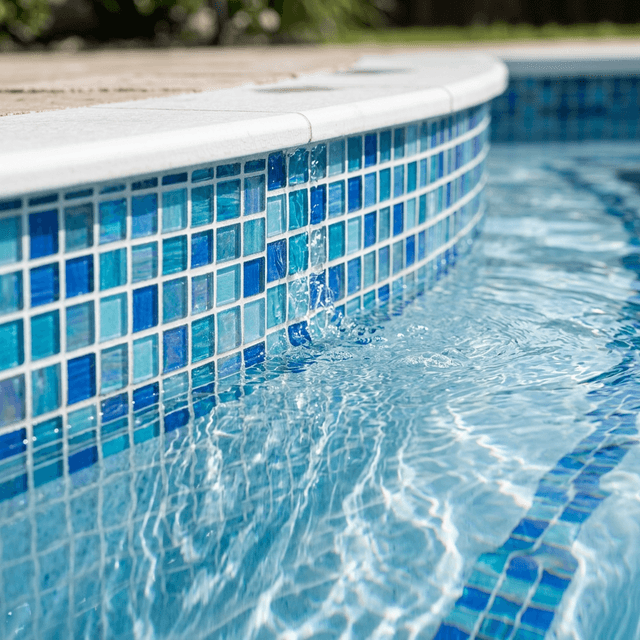
What they look like: White, chalky deposits. Gray scaling along the waterline or tile. White crusty buildup on tile, waterfalls, and spillovers.
Common causes:
- High calcium hardness (very common in DFW — our water is hard)
- High pH causing calcium to precipitate
- Evaporation concentrating calcium at the waterline
- Salt chlorine generators accelerating scale formation
- Hard water splashing onto tile and coping
How to confirm: Apply muriatic acid to the deposit with a sponge. If it fizzes and dissolves, it's calcium.
Purple and Black Stains → Manganese or Copper
What they look like: Dark purple, black, or very dark brown spots.
Common causes:
- Manganese in well water
- Copper at high concentrations combined with chlorine
- Severe iron staining that's oxidized to black
How to confirm: Vitamin C tablet test. If it lightens, it's metal-based.
How to Remove Each Stain Type
Removing Organic Stains (Green/Brown)
Method 1: Chlorine treatment
- Brush the stained area thoroughly
- Apply granular calcium hypochlorite (cal-hypo) directly to the stain
- Let it sit for 10-15 minutes
- Brush again
- For stubborn stains, use a chlorine wash: dissolve shock in a bucket and pour directly over the stain
Method 2: Enzyme treatment
- Add a pool enzyme product to break down organic compounds
- Run the filter for 48 hours
- Brush affected areas daily
- Enzyme products work slowly but effectively for widespread organic staining
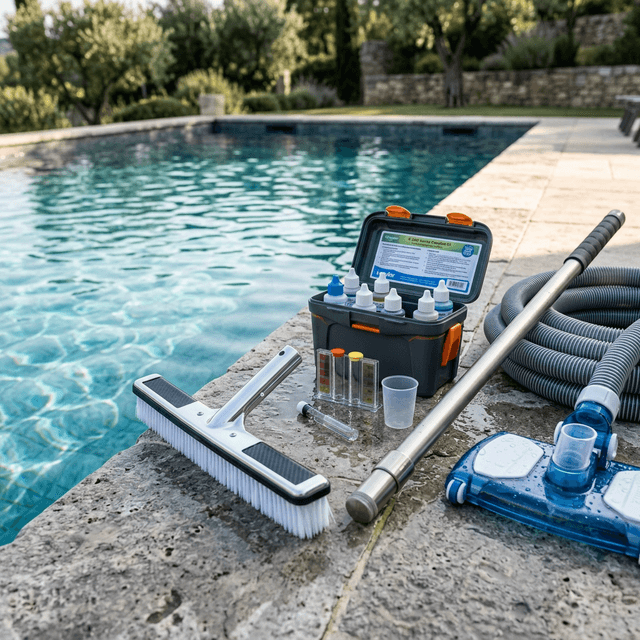
Products: Pool shock (cal-hypo), enzyme cleaner, stiff pool brush. All available at our Northlake store.
Removing Metal Stains (Iron, Copper, Manganese)
WARNING: Do NOT shock a pool with metal stains. Chlorine oxidizes metals and makes stains worse and more permanent.
Method: Ascorbic acid treatment
- Lower chlorine to 0 ppm (turn off chlorinator and let it burn off naturally, or use sodium thiosulfate to neutralize)
- Lower pH to 7.0-7.2
- Add ascorbic acid (vitamin C) at a rate of 1 lb per 10,000 gallons
- Brush all stained surfaces
- Run the pump for 24 hours
- Stains should lift within 24-48 hours
- After stains clear, add a metal sequestrant to keep metals in solution
- Slowly bring chlorine back up over the next few days while maintaining sequestrant
For spot treatment: Crush a vitamin C tablet and rub it directly on small stains. This works great for isolated spots.
Ongoing prevention: Use a metal sequestrant monthly. This is especially critical for well water users in Argyle, Krum, Ponder, and Bartonville.
Products: Ascorbic acid (vitamin C), metal sequestrant, pH reducer (muriatic acid). We carry professional-grade metal stain treatment kits at our store and online shop.
Removing Calcium/Scale Stains (White/Gray)
Method 1: Acid wash (tile line and waterline)
- Lower the water level below the stained area
- Apply muriatic acid with a sponge or acid wash pump
- Scrub with a pumice stone or scaling pad
- Rinse thoroughly
- Refill pool and rebalance chemistry
Method 2: Scale remover product
- Apply a commercial scale remover to affected areas
- Let it sit per product directions
- Scrub with a stiff brush or pumice stone
- For underwater scale, use a submersible scale removal product
Method 3: pH and chemistry adjustment
- Lower pH to 7.0-7.2
- Add a scale inhibitor/sequestrant
- Run the pump for 48 hours
- Brush scaled areas daily
- The lower pH helps dissolve calcium deposits slowly
Products: Muriatic acid, pumice stone, scale remover, tile cleaner. Available at our Northlake store. For professional tile cleaning, contact us.
Prevention: Stop Stains Before They Start
Preventing organic stains
- Skim regularly — don't let leaves sit on the pool floor
- Trim overhanging trees — especially live oaks, pecans, and mulberries common in DFW
- Use a robotic pool cleaner — daily automated cleaning prevents debris from sitting long enough to stain
- Maintain chlorine levels — adequate chlorine (2-4 ppm) breaks down organic matter before it stains
- Brush weekly — prevents biofilm that leads to staining
Check out our pool vacuum and robotic cleaner selection for automated debris management.
Preventing metal stains
- Test for metals before adding any chemicals (we offer free water testing at our store)
- Use a metal sequestrant monthly — this keeps dissolved metals from depositing on surfaces
- Maintain proper pH (7.2-7.6) — low pH dissolves metals from equipment; high pH causes metals to precipitate and stain
- Avoid copper-based algaecides — use polyquat algaecides instead
- If you have well water, treat for metals proactively with sequestrant from day one
- Check your heater — copper heat exchangers corrode when pH is low, releasing copper into pool water
Preventing calcium/scale
- Maintain calcium hardness below 400 ppm
- Keep pH below 7.8 — high pH accelerates calcium precipitation
- Use a scale inhibitor monthly — especially important in DFW's hard water
- Clean tile line regularly — easier to prevent buildup than remove it
- Monitor Langelier Saturation Index (LSI) — your pool water should be slightly below 0 (slightly aggressive) to prevent scale formation
- Consider a partial drain annually to reduce calcium concentration from evaporation
When to Call a Professional
- Metal stains covering large areas — whole-pool ascorbic acid treatment requires precise execution
- Deep plaster staining that doesn't respond to surface treatment
- Recurring stains despite treatment — indicates an ongoing source that needs identification
- Structural staining from rebar or embedded metal
- Tile and waterline scale that's thick and hardened
Simplified Pools provides professional stain identification and treatment across DFW North. We carry all stain treatment products at our supply store and our technicians have experience with every stain type common in North Texas — especially the iron and mineral staining from well water in our service area.
Schedule stain treatment or call (469) 455-1054.
Dealing with pool stains in DFW? Bring a water sample to our Northlake store for free testing. We'll identify the stain source and recommend the right treatment. Simplified Pools — Northlake, Argyle, Flower Mound, Trophy Club, and all DFW North. Get help today.