Pool LED Lighting Upgrade: Transform Your Backyard with Modern Pool Lights
Pool lighting has changed completely in the last decade. Modern LED pool lights use 80% less electricity, last 30,000-50,000 hours (compared to 1,000-5,000 for incandescent), offer millions of color combinations, and can be controlled from your phone. If your pool still has the original incandescent or halogen light from when it was built, upgrading to LED is one of the best return-on-investment improvements you can make -- it transforms the look of your pool at night while cutting lighting energy costs dramatically.
Here's everything you need to know about pool LED lighting: the types available, what the upgrade involves, what it costs, and how to create the backyard ambiance you want.
LED vs. Incandescent Pool Lights: Why Upgrade?
Energy savings
The energy difference between LED and incandescent pool lights is enormous:
| Metric | Incandescent | LED |
|---|---|---|
| Wattage | 300-500 watts | 30-65 watts |
| Monthly cost (4 hrs/day) | $15-$25 | $2-$4 |
| Annual cost | $180-$300 | $24-$48 |
| Annual savings with LED | -- | $150-$250 |
Over the 30,000+ hour lifespan of an LED light, you'll save $1,500-$3,000 in electricity compared to running an incandescent bulb -- far more than the cost of the LED upgrade itself.
For more ways to reduce your pool's energy costs, see our energy saving tips guide.
Lifespan comparison
- Incandescent bulb: 1,000-5,000 hours (1-3 years of typical use)
- Halogen bulb: 2,000-4,000 hours (1-2 years)
- LED light: 30,000-50,000 hours (15-25+ years of typical use)
That means an LED pool light installed today may never need replacement during your ownership of the home. Incandescent bulbs need replacing every 1-3 years, and each replacement on a pool light means pulling the fixture, draining the niche, and often hiring an electrician.
Light quality and color
- Incandescent: Warm white only, dims as the bulb ages, single brightness setting
- LED: Full spectrum white (warm, cool, daylight), plus millions of color options (red, blue, green, purple, and everything in between), programmable color shows, adjustable brightness
Heat output
- Incandescent bulbs produce significant heat -- a 500-watt bulb generates enough heat to damage the niche housing over time, degrade gaskets, and even crack lens covers
- LED lights run cool -- minimal heat output, extending the life of the fixture, gaskets, and lens
Types of Pool LED Lights
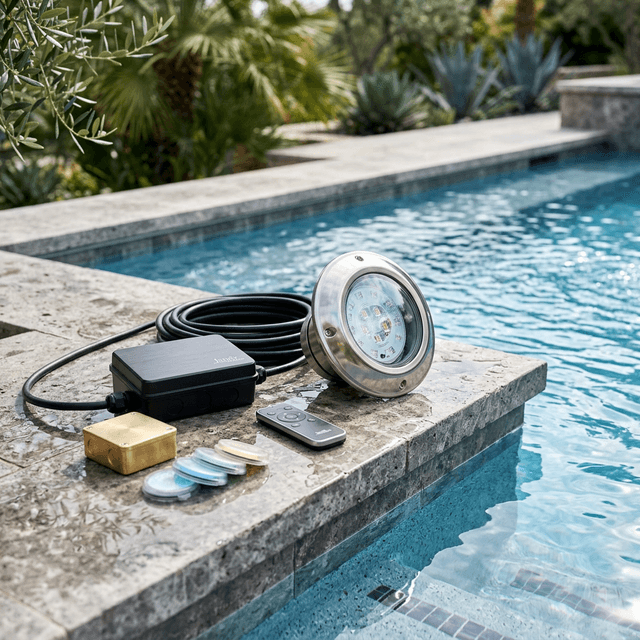
1. Niche-mounted pool lights (standard retrofit)
These are the most common type for existing pools. They mount in the same niche (the housing built into the pool wall) that your current incandescent light occupies.
How retrofit works:
- Remove the existing incandescent fixture
- Install a new LED fixture in the same niche
- Use the existing conduit and wiring (in most cases)
- No structural modification to the pool required
Best brands:
- Pentair IntelliBrite 5G -- the industry standard for color LED pool lights, excellent color saturation, works with Pentair automation
- Hayward ColorLogic -- vivid colors, built-in light shows, compatible with Hayward OmniLogic
- Jandy WaterColors -- wide color range, integrates with Jandy iAqualink
- PAL Lighting -- solid aftermarket option, good color mixing, works with most automation systems
Price range: $300-$800 per fixture (light only, not including installation)
Best for: Any pool with an existing light niche -- this is the standard upgrade path for most pool owners
2. LED bulb replacement (simplest option)
If your existing fixture is in good condition, you may be able to simply replace the incandescent bulb with an LED bulb that fits the same socket.
How it works:
- Remove the existing bulb from the fixture
- Screw in an LED replacement bulb (usually the same E26 or R40 base)
- Reinstall the fixture in the niche
Popular options:
- ColorSplash LED replacement bulbs -- fit standard pool light sockets
- Pentair SAM LED replacement -- designed for Pentair housings
- Various aftermarket LED pool bulbs -- available in white and color-changing versions
Price range: $50-$200 per bulb
Pros:
- Cheapest option
- Simplest installation (often DIY-possible)
- No new wiring or fixture needed
Cons:
- Color quality and brightness are typically lower than purpose-built LED fixtures
- May not be compatible with all existing housings
- Fewer features (limited color shows, no automation integration)
- Gasket and lens on old fixture may need replacement anyway
Best for: Budget upgrades, or as a temporary solution before a full fixture replacement
3. Surface-mounted LED lights
These mount directly to the pool wall or floor without a niche. They're low-profile and can be added to pools that never had lights or that need additional lighting points.
How they work:
- A low-profile LED housing mounts to the pool wall surface using screws or adhesive
- Wiring runs through the pool wall via a small conduit fitting
- Some models are battery or solar powered (no wiring needed, but limited runtime)
Popular options:
- Pentair GloBrite -- very low profile, nicheless design, fits through a small 1" conduit
- Hayward Universal ColorLogic -- nicheless design, mounts on wall return fittings
- PAL Treo -- small, nicheless LED that fits in a standard return fitting
Price range: $150-$500 per light
Best for: Adding lights to pools without existing niches, supplemental lighting, spa lights, tanning ledge lights
4. Floating LED lights
Battery or solar-powered lights that float on the pool surface. These are decorative accent lights, not primary pool illumination.
Price range: $15-$100
Best for: Parties, events, ambiance. Not a replacement for permanent pool lighting.
5. Fiber optic pool lighting
Fiber optic systems use a single light source (illuminator) that transmits light through fiber optic cables to multiple points around the pool.
Price range: $500-$2,000+ for a complete system
Pros:
- No electricity in the water (the illuminator is outside the pool)
- Multiple light points from a single source
- Starfield effects on the pool floor
Cons:
- Dimmer than direct LED lights
- More complex installation
- Illuminator bulb replacement required (though LED illuminators are now available)
- Being largely replaced by nicheless LEDs
Best for: Decorative accent lighting, new construction with custom designs
6. Landscape and perimeter LED lighting
While not pool lights per se, landscape lighting around the pool area dramatically enhances the overall nighttime experience.
Types:
- Deck-mounted uplights -- illuminate trees, walls, and structures
- Step and path lights -- safety lighting on pool decks and walkways
- Underwater bench and ledge lights -- illuminate shallow areas
- Fire and water feature lighting -- LED lights inside fountains, bubblers, and fire bowls
For more on water features and lighting combinations, see our pool water features and fountains guide.
Color Options and Programming
Modern LED pool lights offer far more than simple white illumination.
Fixed color vs. color-changing
- Fixed white LED: Produces a single shade of white (warm, cool, or daylight). Least expensive, simplest
- Fixed single color LED: Produces one color (blue is most popular). Inexpensive, no controller needed
- Color-changing LED: Produces a full spectrum of colors and white shades. Controlled by a switch, remote, or automation system. Most popular choice
Color show modes
Most color-changing LED pool lights include pre-programmed light shows:
- Fixed colors: Red, blue, green, magenta, cyan, amber, white (and shades of each)
- Slow color fade: Gradually cycles through colors over minutes
- Fast color change: Rapid cycling through the color spectrum
- American mode: Red, white, and blue rotation
- Party mode: Fast, random color changes
- Romance mode: Slow transitions through warm colors
- Caribbean mode: Aqua and tropical color transitions
How color control works
Depending on your setup, you control colors through:
Simple switch (no automation):
- Turn the light off and back on rapidly to cycle through modes
- Each off/on cycle advances to the next color or show
- Simple but imprecise -- you have to cycle through all modes to get back to the one you want
Dedicated remote or controller:
- Many LED fixtures come with a handheld remote or wall-mounted controller
- Select specific colors, shows, and brightness levels directly
- Mid-range option for pools without full automation
Pool automation system:
- Pentair IntelliCenter, Hayward OmniLogic, and Jandy iAqualink all integrate with their respective LED lights
- Control colors, shows, brightness, and scheduling from an app on your phone
- Set lights on timers (turn on at sunset, off at bedtime)
- Create scenes that coordinate lights with other features (spa jets, water features, heater)
For full details on automation integration, see our pool automation systems guide.
Installation Process
Standard niche retrofit (most common)
This is the typical upgrade path for pools with existing incandescent lights:
Step 1: Turn off power
- Shut off the breaker for the pool light circuit at the main panel
- Verify power is off with a voltage tester
- Lock out the breaker to prevent accidental re-energizing
Step 2: Remove the existing fixture
- Remove the single screw securing the fixture to the niche
- Pull the fixture out of the niche -- the extra cord coiled behind it allows you to bring it to the pool deck
- Set the fixture on the deck (do not let it hang by the cord)
Step 3: Disconnect and remove the old fixture
- Open the junction box (usually on the deck near the pool equipment)
- Disconnect the wiring
- Pull the old fixture and cord out through the conduit
Step 4: Install the new LED fixture
- Feed the new LED fixture's cord through the conduit from the niche to the junction box
- Connect the wiring at the junction box (line, neutral, ground)
- Coil the excess cord neatly behind the fixture in the niche
- Seat the fixture in the niche and secure with the screw
- Ensure the gasket or O-ring creates a watertight seal
Step 5: Test and program
- Restore power at the breaker
- Turn on the light and verify operation
- Program color modes, shows, or automation integration
Nicheless light installation (adding new lights)
Adding lights where none existed before requires more work:
- Core drill through the pool wall to create a conduit penetration
- Install the conduit fitting and seal it watertight
- Run wiring from the light location to a junction box and then to the electrical panel
- Mount the light on the pool wall
- Wire to a dedicated circuit with proper GFCI protection
This is always a professional job requiring a licensed electrician and often a pool contractor.
DIY vs. Professional Installation
What you can DIY
- LED bulb replacement in an existing fixture (if you're comfortable working with the fixture and following safety procedures)
- Floating lights (no installation needed)
- Low-voltage landscape lighting around the pool area (12V systems are generally safe for handy homeowners)
What requires a professional
- Niche fixture replacement -- involves working with electrical connections in a wet environment. In Texas, pool electrical work must meet NEC Article 680 requirements
- New light installation -- core drilling, conduit work, and new electrical circuits require licensed contractors
- Automation integration -- programming and wiring to automation systems
Our recommendation: For any work involving the pool light niche, junction box, or electrical connections, hire a licensed electrician or pool professional. The safety risks of improper pool electrical work are severe.
Safety Considerations
Pool lighting involves electricity near water, which makes safety requirements strict and non-negotiable.
GFCI protection
All pool lights must be on a Ground Fault Circuit Interrupter (GFCI) protected circuit. This is code-required (NEC 680.23) and exists to prevent electrocution.
- The GFCI breaker detects any current leakage (as little as 5 milliamps) and trips instantly
- Test your GFCI monthly -- press the "test" button to verify it trips, then reset
- If your pool light is not on a GFCI circuit, have an electrician add one before doing anything else
Bonding
Pool lights must be bonded to the pool's bonding grid -- a continuous electrical connection between all metal components in and around the pool. This equalizes voltage potential and prevents shock.
- Bonding is done during pool construction
- If you're adding a new light, the bonding grid must be extended to include it
- This is not optional -- it's a life-safety requirement
Low-voltage systems
Some LED pool lights operate on low voltage (12V) stepped down from line voltage by a transformer:
- 12V systems are inherently safer in water than 120V systems
- The transformer must still be GFCI protected
- Many nicheless lights use 12V for added safety
NEC Article 680 compliance
The National Electrical Code Article 680 governs all pool electrical installations. Key requirements include:
- GFCI protection for all pool circuits
- Minimum distances between lights, outlets, and the pool edge
- Proper bonding of all metal components
- Watertight conduit and junction box requirements
- Specific wire types rated for wet locations
Always verify that any pool electrical work is permitted and inspected by your local jurisdiction. In Northlake, Trophy Club, Roanoke, and surrounding DFW cities, building permits are typically required for new pool electrical work.
Cost Breakdown
LED bulb replacement (simplest)
| Item | Cost |
|---|---|
| LED replacement bulb | $50-$200 |
| Gasket/O-ring (if needed) | $10-$30 |
| DIY installation | $0 |
| Total | $60-$230 |
Niche fixture retrofit (most common)
| Item | Cost |
|---|---|
| LED fixture (Pentair, Hayward, Jandy) | $300-$800 |
| Gasket and hardware | $15-$30 |
| Professional installation labor | $150-$400 |
| Total | $465-$1,230 |
New nicheless light addition
| Item | Cost |
|---|---|
| Nicheless LED fixture | $150-$500 |
| Core drilling and conduit | $200-$500 |
| Electrical wiring and connections | $200-$500 |
| GFCI breaker (if new circuit needed) | $50-$100 |
| Permit (if required) | $50-$150 |
| Total | $650-$1,750 |
Complete pool lighting redesign
| Item | Cost |
|---|---|
| 2-3 LED pool lights | $600-$2,400 |
| Spa light | $300-$800 |
| Landscape lighting (8-12 fixtures) | $1,500-$4,000 |
| Automation integration | $200-$500 |
| Installation labor | $500-$2,000 |
| Total | $3,100-$9,700 |
Return on investment
A single LED niche retrofit typically pays for itself in 3-5 years through electricity savings alone, and the light will continue saving money for 15-25+ years beyond that. It also adds real value to your home -- a well-lit pool with color-changing LED lights is a significant selling feature.
Smart Home Integration
Modern pool LED lights can integrate with your smart home ecosystem through pool automation systems.
Automation system integration
| Automation System | Compatible Lights | App Control | Voice Control |
|---|---|---|---|
| Pentair IntelliCenter | IntelliBrite 5G, GloBrite | ScreenLogic app | Alexa, Google (via integration) |
| Hayward OmniLogic | ColorLogic, Universal ColorLogic | OmniLogic app | Alexa, Google (native) |
| Jandy iAqualink | WaterColors | iAqualink app | Alexa, Google (native) |
What smart integration enables
- Scheduled on/off times -- lights turn on at sunset and off at your bedtime automatically
- Color scenes -- save your favorite color combinations and recall them with one tap
- Coordination with other features -- turn on the spa light, jets, and heater together with a single "Spa Night" command
- Voice control -- "Alexa, set pool lights to blue" or "Hey Google, turn on pool lights"
- Geofencing -- lights turn on when you arrive home (with automation system support)
- Remote access -- turn lights on from anywhere via smartphone
For a complete guide to automation options, see our pool automation systems guide.
Creating Ambiance: Lighting Design Tips
For everyday use
- Cool white (5000K-6500K) provides the best visibility for swimming and safety
- A single niche light is sufficient for pools up to about 400 square feet
- Two lights (one at each end) provide better coverage for larger pools
- A separate spa light keeps the spa visible when the pool light is on a different color
For entertaining
- Blue or cyan creates a resort-like feel -- the most popular color for evening entertaining
- Slow color fade provides ambient visual interest without being distracting
- Coordinate pool lights with landscape lighting for a cohesive look
- Warm white or amber for a relaxed, intimate atmosphere
For holidays and events
- Red and green for the holiday season
- Red, white, and blue for Independence Day
- Team colors for game day parties
- Fast color change for kids' pool parties
Dos and Don'ts
- Do point uplights at trees and architectural features, not into neighbors' windows
- Do use warm white path lighting for safety on pool decks
- Do ensure adequate lighting at steps, diving boards, and entry points for safety
- Don't over-light the space -- subtlety creates better ambiance than brightness
- Don't aim landscape lights directly at the pool surface (creates glare and reduces visibility into the water)
- Don't forget about light pollution -- be a good neighbor with directional fixtures
DFW Pool Lighting Considerations
Texas electrical codes
Texas follows the NEC with local amendments. DFW municipalities (Northlake, Trophy Club, Roanoke, Denton, Fort Worth) generally require:
- Permits for new pool electrical circuits
- Licensed electrician for pool light installation
- Inspection after installation
- GFCI protection on all pool circuits
Storm and surge protection
DFW's spring and summer storm seasons bring lightning and power surges that can damage LED control boards. Protect your investment:
- Install a surge protector at the pool equipment panel
- Consider a whole-house surge protector ($200-$400 installed)
- Unplug low-voltage transformers during severe storms if practical
Heat considerations
Texas summer heat doesn't significantly affect LED pool lights (since they're underwater and run cool), but surface-mounted transformers and junction boxes on the equipment pad should be shaded if possible to extend component life.
Shop Pool LED Lights and Accessories
Browse LED pool lights, replacement bulbs, transformers, and accessories at:
- Northlake Store -- see LED light demos, get expert advice on fixtures and compatibility
- Online Shop -- order LED lights and accessories with local pickup or shipping
Ready to Upgrade Your Pool Lighting?
Whether you want a simple LED bulb swap or a complete lighting redesign with color-changing lights and automation integration, we can help. We install pool LED lights from Pentair, Hayward, Jandy, and PAL Lighting, and we can integrate them with your existing automation system or help you add one.
Our weekly pool service starts at $165/month -- and our service customers get priority scheduling and preferred pricing on equipment installations like LED lighting upgrades.
Contact Simplified Pools | (469) 455-1054 | View Our Services