A pool pad runs on tight seals. When a pump basket fills with churning air bubbles, a filter tank collar seeps water onto the concrete, or a chlorinator lid binds up so tight you need a strap wrench to loosen it, the culprit is almost always a rubber o-ring. Rubber needs lubrication to seat without pinching, to keep air from sneaking past under vacuum, and to keep chemical-treated water from hardening the elastomer.
Aladdin Magic Lube is the standard lubricant found on utility trucks and equipment pads everywhere. Even so, people regularly grab the wrong formulation, slather on far too much, or use it on parts where grease causes outright equipment failure.
Red Tube vs. Blue Tube: Understanding the Difference
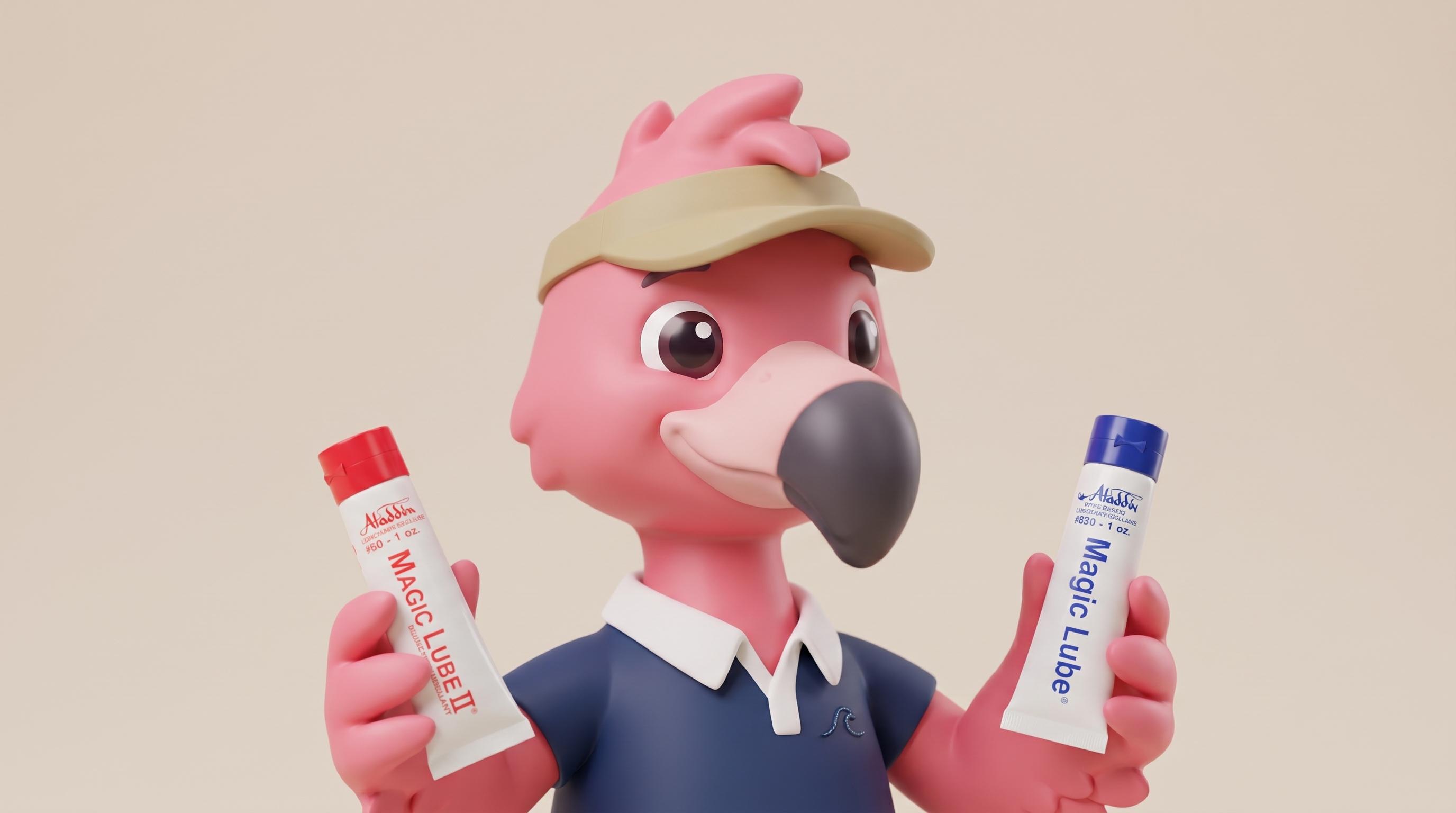
Aladdin manufactures two distinct products under the Magic Lube name, and the base chemistry determines where each one belongs.
Original Magic Lube (Red Tube / Red Writing)
The standard ALADDIN 1 oz Magic Lube Tube is a PTFE-based (Teflon), petroleum-free lubricant. It has a thick, tacky consistency that clings tightly to rubber and plastic even when exposed to rushing water.
Because it resists wash-out and creates a heavy barrier, the original red formula works especially well on:
- Pump strainer lid o-rings (where high suction pulls air past dry rubber)
- Filter tank belly band o-rings
- Threaded union o-rings on PVC plumbing lines
- Chlorinator cover seals
Magic Lube II (Blue Tube / Blue Writing)
Aladdin Magic Lube II Silicone Lubricant 1oz is a pure silicone-based lubricant. It is non-melting, slicker than the original formula, and handles wide temperature swings without thickening in the cold or thinning under direct sun.
Silicone does not attract dirt quite as aggressively as tacky PTFE grease, making Magic Lube II the better option for moving components:
- Push-pull backwash valve pistons and internal o-rings
- Jandy-style diverter valve internal stems
- Plunger valves and multi-port valve rotor gaskets
- Low-temperature applications where standard grease stiffens
Where to Apply Magic Lube on Pool Equipment
Every time you open an equipment connection, that o-ring should be cleaned, inspected, and lightly coated before you seal it back up.
The Pump Strainer Lid
When a pump runs, the suction side operates under vacuum. A dry or flattened pump lid o-ring allows microscopic amounts of air to bypass the seal. You see this as a pocket of air churning under the clear lid, micro-bubbles blowing out your return jets, or a pump that loses prime when it shuts off. A thin film of Magic Lube fills small imperfections in the plastic lid groove and holds vacuum.
Filter Tank O-Rings
Whether you take apart a cartridge, D.E., or sand filter, the large tank o-ring must compress smoothly when you tighten the metal clamp. If you tighten a dry o-ring inside a dry channel, the rubber pinches and bunches, leading to leaks or a dangerous blowout. Coating the ring ensures the tank halves slide together evenly. If you are opening the tank for seasonal maintenance, review our guide to cartridge filter cleaning for safe teardown steps.
Union Connections and Drain Plugs
Quick-disconnect unions on variable-speed pumps, salt cells, and heater manifolds rely on small o-rings recessed into a plastic face. A dab of lube prevents the o-ring from twisting when you hand-tighten the union collar. The same applies to winterization drain plugs on pumps and filters.
Places You Should Never Put Magic Lube
Lubricant solves sealing problems, but putting it in the wrong spot can ruin expensive components.
Mechanical Pump Shaft Seals
The mechanical shaft seal behind your pump impeller has two smooth, polished faces—one ceramic and one carbon. These faces spin against each other at thousands of RPM, cooled strictly by the water in the volute. Never put Magic Lube, silicone, or any other grease onto the polished faces of a mechanical seal. Grease traps grit, burns under friction, and causes immediate seal failure. If your pump is leaking water from the bracket directly behind the motor, you need a pump seal repair, not lubricant.
Electronic Sensors and Probes
Never allow lubricant to touch the glass bulb of a pH sensor, the sensing tips of an ORP probe, or the internal plates of a salt cell. Silicone and PTFE leave an insulating film that prevents the sensor from reading the water chemistry accurately.
Can you use Vaseline instead of Magic Lube on pool O-rings?
No. Vaseline and other petroleum jellies should never touch pool equipment.
Most pool o-rings are made from synthetic rubber compounds such as EPDM, Buna-N (nitrile), or neoprene. Petroleum jelly is a hydrocarbon that chemically reacts with these elastomers. Within weeks, the petroleum breaks down the rubber polymer chains, causing the o-ring to swell to nearly twice its original thickness, soften into a sticky mess, and lose its tensile strength.
Once an o-ring swells from petroleum contact, it will never fit back into its groove. A single application of Vaseline usually ruins the seal permanently. Both original Magic Lube and Magic Lube II are 100% petroleum-free and formulated specifically not to degrade synthetic rubbers.
How to Clean and Lube an O-Ring Step by Step
Putting fresh lubricant on top of old dirt simply creates grinding compound that tears up the rubber. Follow this sequence every time:
- Remove and wipe: Take the o-ring out of its channel. Wipe it down completely using a clean rag or paper towel to strip off old grease, pine needles, and sand.
- Clean the channel: Run a damp cloth through the plastic groove where the o-ring sits. Debris trapped in the track causes just as many air leaks as a dirty ring.
- Inspect the rubber: Bend the o-ring between your fingers and look for dry rot, hairline cracks, flat spots, or gouges. If the ring feels brittle or looks permanently flattened, replace it rather than trying to save it with lube.
- Apply a thin film: Squeeze a pea-sized dab of Magic Lube onto your index finger and thumb. Pull the o-ring through your fingers until the entire surface has a light, even sheen. You want the rubber to look wet, not covered in thick clumps. Excess lubricant simply squeezes out of the joint and collects windblown dirt.
- Seat flat: Place the ring back in its channel, ensuring it lies flat without twisting or stretching.
When to Call a Pro
Lubrication fixes dry seals, but it cannot fix warped plastic or worn hardware. If you apply fresh Magic Lube to a clean o-ring and still hear air hissing into the pump basket, water continues spraying from a filter seam, or a union leaks despite being hand-tight, the equipment itself may be distorted from heat or pressure. Cracked strainer pots, warped pump lids, and overtightened union collars require replacement parts and proper alignment. If you are dealing with a leak that lube will not resolve, an equipment-pad leak repair will get the system holding pressure safely again.
If you need a fresh tube of lubricant or help matching an o-ring to size, stop by our store in Northlake, Texas, or order directly from our catalog.
What we'd use for this
Stocked at our Northlake store — free pickup today, or same-day DFW delivery.