Cloudy Pool Water: 7 Causes and How to Fix Each One Fast
Cloudy pool water is the most common pool problem homeowners face. In most cases, cloudy water comes from one of seven causes: poor filtration, high pH, low chlorine, high calcium hardness, early algae growth, high total dissolved solids, or environmental debris. The fix depends entirely on diagnosing the right cause — applying the wrong treatment wastes money and can make the problem worse.
Here's how to figure out exactly what's making your pool cloudy and fix it within 24-48 hours.
Why Cloudy Pool Water Matters
Cloudy water isn't just ugly — it's a safety and health concern.
- Drowning risk: You can't see the bottom of a cloudy pool, which is dangerous for children and weak swimmers
- Bacteria growth: Cloudiness often indicates insufficient sanitation
- Equipment damage: The particles causing cloudiness can clog filters and damage pump seals
- Surface staining: Suspended minerals can permanently stain plaster and tile
- Chemical waste: Adding chemicals to undiagnosed cloudy water wastes money
The faster you identify and fix the cause, the less damage to your pool and wallet.
Cause 1: Poor Filtration (Most Common)
What it looks like: Evenly cloudy throughout the pool, not improving over time.
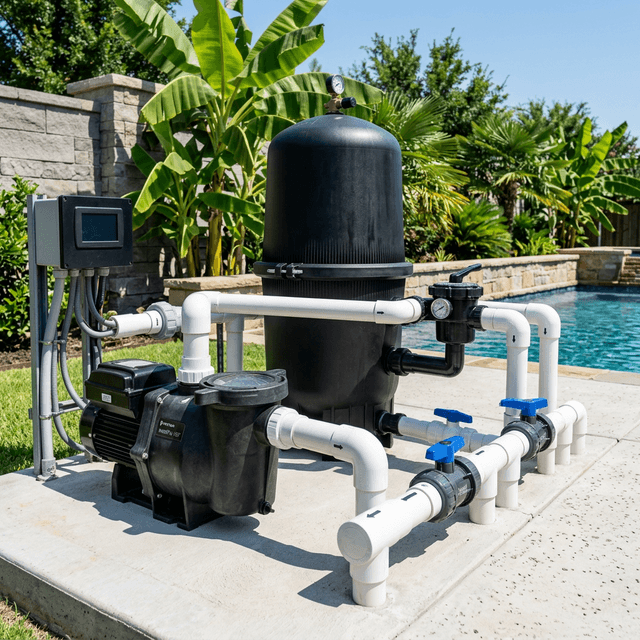
Your filter is the heart of water clarity. If it's not running enough or not functioning properly, particles stay suspended.
Common filtration problems
- Filter not running long enough: Pools need 8-12 hours of filtration daily in summer. In Texas heat, 10-12 hours minimum
- Dirty or clogged filter: Sand filters need backwashing when pressure rises 8-10 PSI above clean baseline. Cartridge filters need cleaning every 2-4 weeks
- Worn filter media: Sand should be replaced every 5-7 years. Cartridge elements every 1-2 years. DE grids every 5-8 years
- Pump too small: If your pump can't turn over the full pool volume in 8 hours, filtration will always struggle
How to fix it
- Check your filter pressure gauge — if it's 8-10 PSI above your clean starting pressure, clean or backwash the filter
- Increase run time to 12+ hours daily until water clears
- Inspect filter media for wear, channeling (in sand filters), or tears (in cartridge/DE)
- If the filter is old, consider upgrading to a cartridge filter system — they catch particles down to 10-15 microns vs sand filters at 20-40 microns
Products that help
Cartridge filter cleaner removes oils, minerals, and scale that reduce filter efficiency. We carry professional-grade filter cleaning solutions at our Northlake store and on our online shop. A clean filter can improve water clarity within hours.
Variable-speed pumps let you run filtration longer at lower speeds, saving energy while improving water clarity. We install and service all major brands including Pentair and Hayward — contact us for a quote.
Cause 2: High pH (Very Common in Texas)
What it looks like: Milky, whitish cloudiness. Water feels slippery.
When pH rises above 7.8, calcium and other minerals start falling out of solution and create visible cloudiness. Texas water is naturally alkaline, so pH creep is extremely common here.
Why pH runs high in Texas
- North Texas tap water is naturally alkaline (pH 7.6-8.2 from the tap)
- Concrete and plaster pool surfaces leach alkalinity into the water
- Salt chlorine generators naturally raise pH as part of their operation
- Aeration from water features, spillovers, and returns raises pH
How to fix it
- Test pH — if it's above 7.8, it needs to come down
- Add muriatic acid or dry acid (sodium bisulfate) to lower pH to 7.2-7.6
- For a 15,000-gallon pool at pH 8.0, you'll typically need about 1 quart of muriatic acid
- Add acid with the pump running, pour into the deep end
- Retest after 4-6 hours of circulation
Products that help
pH test strips and digital testers help you monitor pH weekly. We stock professional-grade test kits at our supply store that are far more accurate than basic pool store strips.
Muriatic acid is the most effective pH reducer for Texas pools. We carry both liquid muriatic acid and dry acid alternatives at our Northlake location. Stop by for free water testing and we'll tell you exactly how much you need.
Cause 3: Low Chlorine / Combined Chlorine
What it looks like: Slightly hazy, sometimes with a strong chlorine smell (which actually means not enough free chlorine).
If free chlorine drops below 1.0 ppm, bacteria and algae particles multiply faster than your filter can remove them.
Why chlorine drops in Texas
- UV from intense Texas sun breaks down chlorine rapidly
- Temperatures above 90°F increase chlorine consumption
- Heavy swimmer loads (pool parties, kids) use up chlorine fast
- Lack of cyanuric acid (stabilizer) leaves chlorine unprotected from UV
How to fix it
- Test free chlorine AND combined chlorine (total chlorine minus free chlorine)
- If free chlorine is below 1.0 ppm, shock the pool
- If combined chlorine is above 0.5 ppm, you need breakpoint chlorination (shocking to 10x the combined chlorine level)
- Add cyanuric acid (stabilizer) to maintain 30-50 ppm — this protects chlorine from UV degradation
- For ongoing maintenance, ensure chlorine stays at 2-4 ppm in summer
Products that help
Pool shock (calcium hypochlorite) is the fastest way to boost chlorine levels. We carry both granular shock and liquid chlorine at our Northlake store. For severe cloudiness, we recommend our professional-strength shock products.
Cyanuric acid (stabilizer/conditioner) is essential in Texas. Without it, you'll burn through chlorine 5x faster. We stock stabilizer in multiple sizes — shop online or pick up at our store.
Liquid chlorine is our preferred daily sanitizer for Texas pools because it doesn't add cyanuric acid (which can build up over time from tablets). Available at our Northlake location.
Cause 4: High Calcium Hardness
What it looks like: White, chalky cloudiness that doesn't respond to shocking. May see white scale on tile line.
When calcium hardness exceeds 400 ppm, calcium carbonate precipitates out of solution and creates persistent cloudiness. North Texas water is notoriously hard.
Why calcium is high in DFW
- DFW municipal water averages 200-300 ppm calcium hardness from the tap
- Well water in Argyle, Krum, and Ponder can exceed 600 ppm
- Calcium hypochlorite (cal-hypo) shock adds calcium with every use
- Evaporation concentrates calcium — you add water, calcium stays
How to fix it
- Test calcium hardness — ideal range is 200-400 ppm
- If above 400 ppm, the only reliable fix is partial drain and refill with fresh water
- Drain 25-50% of pool water and refill
- Use a sequestrant/scale inhibitor to keep existing calcium in solution
- Switch to liquid chlorine or dichlor shock instead of cal-hypo to stop adding more calcium
- For ongoing management, use a sequestrant monthly
Products that help
Scale and stain inhibitor (sequestrant) keeps calcium dissolved in water rather than precipitating onto surfaces and creating cloudiness. This is one of the most important products for DFW pool owners. We carry professional-grade sequestrants at our supply store.
Liquid chlorine doesn't add calcium to your water like cal-hypo tablets do. Switching to liquid chlorine is one of the simplest ways to control calcium buildup over time. Available at our Northlake location.
Cause 5: Early Algae Growth
What it looks like: Slightly green tint to the cloudiness. Walls may feel slippery.
Algae begins as invisible microorganisms before becoming visible green blooms. The cloudy stage is your window to catch it before it gets bad.
How to tell if cloudiness is algae
- Water has a faint green or yellow tint
- Pool walls or floor feel slimy when you rub them
- Chlorine drops rapidly after adding (algae consumes chlorine)
- Cloudiness started after a period of low chlorine or heavy rain
How to fix it
- Brush all pool surfaces thoroughly — this breaks up algae colonies
- Shock to at least 30 ppm free chlorine (triple shock)
- Run the pump 24/7 until water clears
- Add algaecide as a preventive after shocking
- Clean or backwash filter frequently during treatment (algae clogs filters fast)
- Vacuum dead algae to waste (not through the filter)
For severe green pool problems, see our complete guide: How to Fix a Green Pool in Texas
Products that help
Algaecide (copper-based or polyquat) prevents algae from returning after treatment. We stock both preventive and treatment-grade algaecides at our store. Polyquat algaecide won't stain or foam.
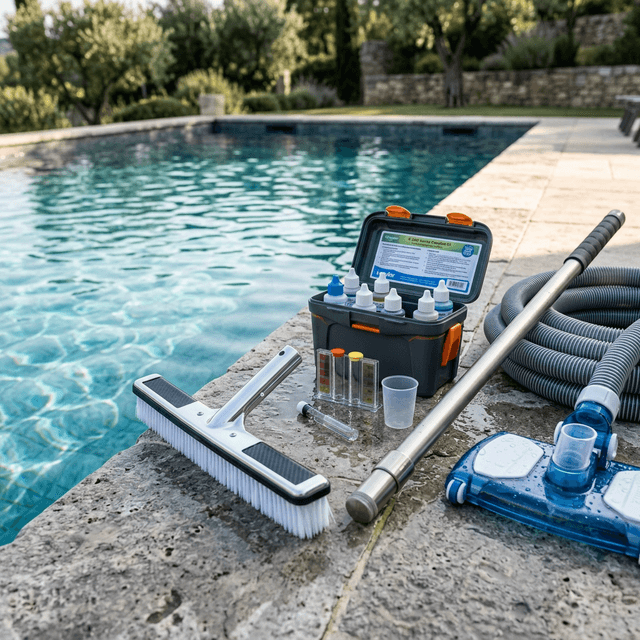
Pool brush and vacuum equipment are essential for algae treatment. A good stainless steel brush makes a massive difference vs a nylon brush. We carry professional-grade pool brushes and vacuums — browse our vacuum selection.
Phosphate remover eliminates algae's food source. If your phosphate levels are above 500 ppb, adding phosphate remover dramatically reduces algae regrowth. Available at our store and online shop.
Cause 6: High Total Dissolved Solids (TDS)
What it looks like: Persistent dull, lifeless look to the water. Chemicals seem less effective.
TDS measures everything dissolved in your water — minerals, chemicals, salts, organics. When TDS exceeds 2,000 ppm (or 1,500 ppm above your fill water), water clarity suffers and chemicals work less efficiently.
Why TDS builds up
- Every chemical you add increases TDS
- Evaporation removes water but leaves dissolved solids behind
- Texas heat means high evaporation rates, concentrating TDS faster
- Salt pools naturally have higher TDS (salt itself is a dissolved solid)
- Years of chemical treatment without draining accumulates TDS
How to fix it
- Test TDS with a digital TDS meter
- If TDS is above 2,500 ppm (non-salt pool), partial drain and refill is the only reliable solution
- Drain 30-50% of pool water
- Refill with fresh water
- Rebalance all chemistry after refilling
- Plan to do partial drains annually in Texas due to high evaporation and chemical usage
Products that help
Digital TDS meter lets you monitor dissolved solids at home. We stock reliable handheld TDS testers at our Northlake store.
Or simply bring a water sample to our store — we offer free water testing that includes TDS along with all other critical parameters.
Cause 7: Environmental Debris and Particles
What it looks like: Cloudiness that worsens after storms, wind, or heavy pollen season.
Dust, pollen, construction debris, and organic matter can overwhelm your filtration system.
Common in DFW because
- Spring pollen season (February-May) is intense in North Texas
- Construction activity in growing areas like Northlake, Justin, and Argyle kicks up dust
- Summer thunderstorms wash debris, dirt, and fertilizer into pools
- Fall leaf season from live oaks and other trees in Flower Mound and Bartonville
How to fix it
- Skim surface debris immediately after storms
- Run the pump for 24 hours after weather events
- Add a water clarifier (flocculant or coagulant) to help the filter catch fine particles
- Clean the filter more frequently during pollen and construction seasons
- Consider a robotic pool cleaner for daily automated debris removal
Products that help
Pool clarifier binds tiny particles together so your filter can catch them. This is the fastest way to clear environmental cloudiness. We carry both liquid clarifier and flocculant at our store and online shop.
Robotic pool cleaners automate daily debris removal, keeping your pool cleaner between service visits. We carry top-rated robotic cleaners — see our vacuum and cleaner selection.
Skimmer socks catch fine debris like pollen before it reaches your filter. Simple, cheap, and effective. Available at our Northlake store.
Quick Diagnosis Chart
| Symptom | Most Likely Cause | First Action |
|---|---|---|
| Milky white cloudiness | High pH or calcium | Test pH and calcium hardness |
| Slight green tint | Early algae | Shock and brush |
| Cloudiness after storm | Environmental debris | Skim, clarifier, run pump 24hr |
| Persistent dull water | High TDS | Test TDS, consider partial drain |
| Strong chlorine smell + cloudy | Combined chlorine | Breakpoint chlorination (heavy shock) |
| Cloudy after adding chemicals | Incompatible chemicals or high calcium | Test all parameters, wait 24hrs |
| Cloudy only in morning, clears by afternoon | Filtration issue | Increase pump run time |
When to Call a Professional
While many cloudy water issues can be DIY, call a professional when:
- Water has been cloudy for more than 3 days despite treatment
- You can't see the drain at the bottom of the deep end
- Multiple chemical readings are off simultaneously
- Equipment sounds wrong — grinding, screeching, or air in lines
- You've already added chemicals without improvement
At Simplified Pools, we diagnose and fix cloudy water problems across the DFW North area. Our weekly maintenance plans ($150-$250/month) prevent cloudiness from happening in the first place. Get a free quote or call us at (469) 455-1054.
Prevention: Keep Your Pool Crystal Clear
The best approach is preventing cloudiness before it starts:
- Run your pump 10-12 hours daily in Texas summer
- Test water 2-3 times per week (pH, chlorine, alkalinity minimum)
- Clean your filter regularly — don't wait until pressure is sky-high
- Use stabilizer (CYA) to protect chlorine from UV
- Brush walls and floor weekly to prevent biofilm buildup
- Shock weekly during peak summer months
- Use sequestrant monthly to control calcium and minerals
Or let us handle all of it with our weekly pool service plans starting at just $165/month. Every visit includes water testing, chemical balancing, equipment checks, and a detailed service report sent to your phone.
Simplified Pools serves Northlake, Argyle, Flower Mound, Trophy Club, Justin, Roanoke, Krum, Ponder, Bartonville, Westlake, and surrounding DFW North communities. Schedule your service today.